
You Already Have the Content. You're Just Using It Once.
Content atomization means taking one strong story, like a parent interview, your annual outcomes data, or a school event, and breaking it into many smaller pieces for different platforms: Reels, carousels, emails, Google Business posts, and landing page quotes. Small charter school teams get more reach from work they're already doing, without burning out.
Here's the thing most charter school marketing directors don't realize: the story you shared in last month's newsletter, the student spotlight you posted on Instagram, the quote a parent gave you at the open house — that's not one piece of content. That's the raw material for a dozen.
In 2026, one of the fastest-growing strategies in content marketing is content atomization: taking a single, high-quality core idea and breaking it into multiple smaller, format-specific assets that work independently across different platforms. Think of it as extracting maximum value from your best material — instead of creating something new every single day and burning out your team in the process.
For charter school leaders managing enrollment with a small staff and a tight budget, this isn't just a trend worth watching. It's a survival strategy.
What is content atomization, and how is it different from repurposing?
Repurposing means converting one format into another — say, turning a blog post into a YouTube video. Content atomization goes further. You're extracting multiple discrete, independently valuable pieces from a single source and adapting each one for a specific context, platform, and audience behavior.
A comprehensive blog post covering several subtopics can be broken down into separate posts, social snippets, email content, infographics, video scripts, and more — each piece standing alone while connecting to the larger story. By creating multi-platform content, you increase the chances that it will be seen by a diverse audience, because not everyone consumes content the same way.
For charter school enrollment marketing, this is a game-changer. Families discover schools in wildly different places — a Facebook scroll at 10pm, a Google search for "best schools near me," an Instagram Reel that a neighbor shared. Atomization ensures your school's story reaches them wherever they are, without requiring you to generate original content from scratch every single time.
Where does a charter school content atom start?
It starts with one cornerstone story.
The key is identifying what atomization practitioners call cornerstone content — a rich, substantive piece that contains multiple themes, data points, or emotional moments you can extract and amplify.
For a charter school, these naturally occur all the time. You just haven't been mining them. A few examples of ready-made cornerstone assets:
- A parent interview or testimonial collected at an open house
- A student's project-based learning showcase or capstone presentation
- Your school's annual outcomes data (graduation rates, college acceptance, test score growth)
- A teacher's classroom innovation story
- A behind-the-scenes look at a school day or special program
Each of these contains enough material to fuel weeks of enrollment-relevant content — if you know how to extract the atoms.
How can your school start atomizing content this month?
1. Turn One Parent Interview into a 10-Touch Campaign
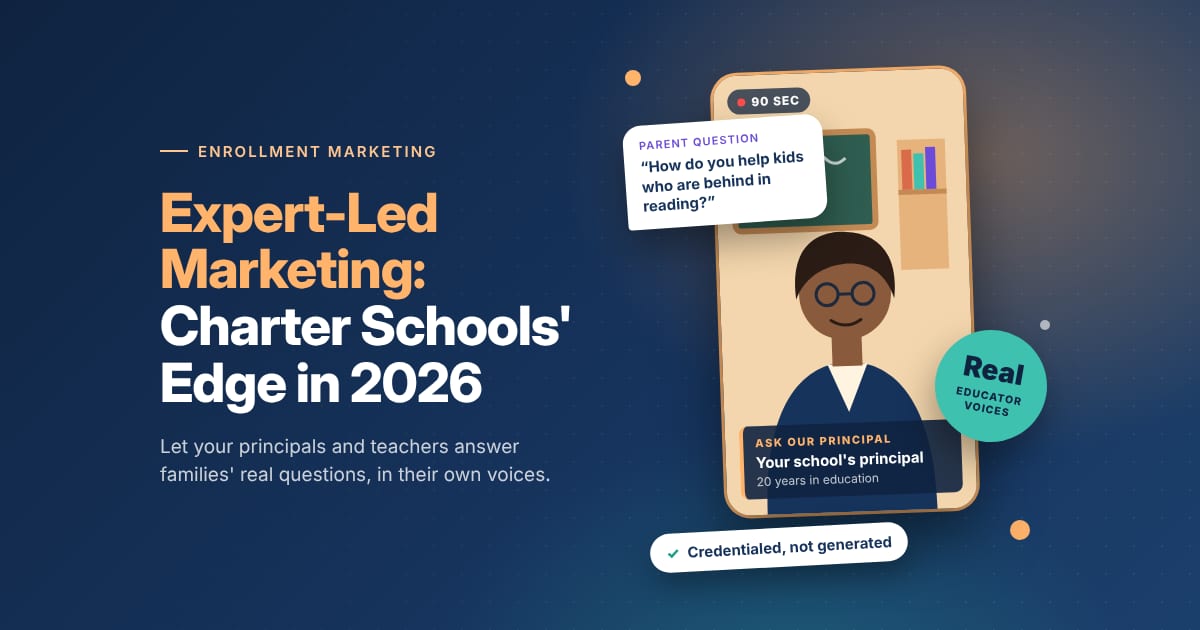
Book a 15-minute recorded conversation with a parent who enrolled their child in your school after comparing options. Ask them three questions: What were you worried about before enrolling? What surprised you most after the first month? What would you tell a family still on the fence?
From that single interview, you can extract:
- A 60-second Instagram Reel (their best soundbite, captioned)
- A Facebook post quoting their answer to question three, with a link to your open house registration
- An email nurture sequence opener for families who've inquired but haven't applied
- A Google Business Profile post featuring their quote and a call to action
- A blog post or FAQ page entry expanding on the concern they named and how your school addresses it
- A text graphic for Instagram Stories or Pinterest
- A verbatim pull quote for your enrollment landing page
That's seven assets from one 15-minute conversation. When you atomize that way, you're not creating more work — you're multiplying the reach of work you were already doing.
2. Build an "Outcomes Atom" Around Your School's Annual Data
Every charter school has accountability data: test score growth, attendance rates, college acceptance numbers, student-to-teacher ratios, extracurricular breadth. Most schools bury this in an annual report that two people read.
Instead, treat your outcomes as a content core and atomize outward:
- An Instagram carousel: one stat per slide, designed on Canva, branded with your school colors
- A short-form video: your principal speaking directly to camera — "Here's what our students accomplished this year in 60 seconds"
- A LinkedIn post (yes, parents are on LinkedIn) framing your outcomes in the context of college and career readiness
- An email subject line test: "100% of our 8th graders will enter high school reading at grade level. Here's how."
- A neighborhood Facebook Group post in the local parent communities you've joined, framed as community pride rather than a pitch
Data-driven charter school enrollment marketing earns trust in ways that promotional copy simply can't. Parents want evidence. Give them the same evidence in five different formats and five different places, and it stops feeling like marketing and starts feeling like reputation.
3. Create a "Content Atom Map" Before Every School Event
Your next open house, student showcase, or community night is a content goldmine — but only if you plan to capture it that way before it happens.
Before the event, create a simple one-page "atom map":
- What's the cornerstone? (e.g., a student presenting their science project to real community judges)
- What photos do we need? (students presenting, parents watching, teacher coaching)
- What video clips do we need? (30-second clip of the student explaining their project, a parent reaction, a teacher's brief commentary)
- What quotes do we need? (one from a student, one from a parent, one from a teacher)
- What data point ties it together? (e.g., "This is the 3rd year we've partnered with local businesses for our showcase")
After the event, you don't sit down to write content. You sit down to assemble it. The cornerstone becomes a blog post or newsletter story. The clips become Reels and Stories. The photos become carousels and Google Business posts. The quotes become email copy and landing page testimonials. The data point becomes a stat graphic.
One evening of community pride becomes three weeks of charter school social media content — all authentic, all enrollment-relevant, all telling the same compelling story from different angles.
Why does atomization work harder than a regular content calendar?
Most charter school content calendars are built around a simple question: What should we post this week? That question produces content that's reactive, inconsistent, and forgettable.
Atomization flips the question to: What is the most powerful story we're sitting on right now — and how many ways can we tell it?
The result is content that builds on itself. Families who see your Instagram Reel get curious and Google your school. They find your blog post. They get retargeted by your Facebook ad using that same parent quote. They receive your email with the outcomes data. By the time they click "request a tour," they've already heard your story in five different voices, on five different platforms, and it all felt coherent — because it was coherent. It started from the same atom.
That kind of layered, multi-platform presence is what separates charter schools with growing waitlists from those scrambling to fill seats every lottery season.
How do you get started?
You don't need a bigger team, a bigger budget, or a brand new marketing strategy. You need to stop treating every piece of content as a single-use asset and start treating your school's best stories as the starting point of a campaign — not the end of one.
Map your next cornerstone. Extract your atoms. Distribute with intention.
If your charter school enrollment marketing feels like a treadmill you can never get off, content atomization is how you finally get ahead of it. Pick one story you already have — and see how many ways you can tell it.
Frequently Asked Questions
What is content atomization?
Content atomization is taking a single, high-quality core idea and breaking it into multiple smaller, format-specific assets that work independently across different platforms. Instead of creating something new every day, your team extracts maximum value from its best material, such as a parent interview, an outcomes report, or a school event.
How is content atomization different from repurposing?
Repurposing converts one format into another, like turning a blog post into a video. Atomization goes further: it extracts multiple discrete, independently valuable pieces from one source and adapts each for a specific platform and audience, such as Reels, email openers, Google Business Profile posts, and landing page quotes.
How many posts can one parent interview create?
A 15-minute recorded parent interview can produce at least seven assets: an Instagram Reel, a Facebook post, an email nurture opener, a Google Business Profile post, a blog or FAQ entry, a text graphic for Stories, and a pull quote for your enrollment landing page.
What is a content atom map?
A content atom map is a one-page plan you make before a school event. It names the cornerstone story and lists the photos, video clips, quotes, and data point you need to capture. Afterward you assemble content instead of writing it from scratch, turning one evening into weeks of posts.