The Most Persuasive Marketer at Your School Doesn't Work for You
She's a mom on Facebook at 9 p.m., telling three other moms in a local parenting group exactly why she transferred her daughter to your school last fall. She has no budget, no brand guidelines, and no content calendar. And she is almost certainly more convincing than anything your marketing team has ever produced.
That's the core insight driving the biggest charter school marketing shift of 2026: user-generated content (UGC) — photos, videos, social posts, and testimonials created voluntarily by your existing families and students — has officially overtaken polished branded content as the most trusted form of marketing. And most charter schools are sitting on a goldmine of it without a system to capture, amplify, or use it strategically.
This isn't a soft brand-awareness play. It's a direct enrollment driver — if you treat it like one.
Why UGC Is Winning Harder Than Ever in 2026
The AI content flood changed the trust equation. As more schools pump out polished AI-written posts and stock-photo ads, authentic parent voices stand out harder by contrast. Consumer trust in AI-generated marketing has dropped sharply, with real customer content scoring 81 out of 100 on perceived authenticity compared to 63 for AI-generated "UGC-style" content — and that gap is widening, not closing.
92% of people trust peer recommendations over traditional advertising. Consumers are 2.4 times more likely to view UGC as authentic compared to brand-created content, and 84% of Gen Z say they trust brands more when real customers appear in their ads. For a charter school trying to reach millennial and Gen Z parents making high-stakes school-choice decisions, those numbers are impossible to ignore.
The enrollment implication is structural, not just social: schools implementing structured ambassador programs report that 35–45% of new enrollments originate from direct parent referrals, compared to baseline rates of 15–20% without formal programs. UGC is the engine underneath those referrals — the content that travels, gets seen, and builds trust before a family ever visits your campus.
3 UGC Tactics Charter Schools Can Launch This Month
Tactic 1: Build a Branded Hashtag — and Actually Promote It
Most schools create a hashtag and forget it exists. The ones winning in 2026 treat their hashtag like an enrollment asset with its own promotion plan.
Pick one hashtag specific to your school community — not just your name, but your identity. Something like #RiverdalePrepFamilies or #SunriseCharterKids. Then build a real promotion cadence around it:
- Print it on enrollment packets, newsletter footers, event signage, and lanyards. Passive promotion doesn't work. Put it everywhere families already look.
- Ask parents and students to use it at every milestone — first day of school, science fair, field day, graduation, teacher appreciation week. Brief them at Back to School Night.
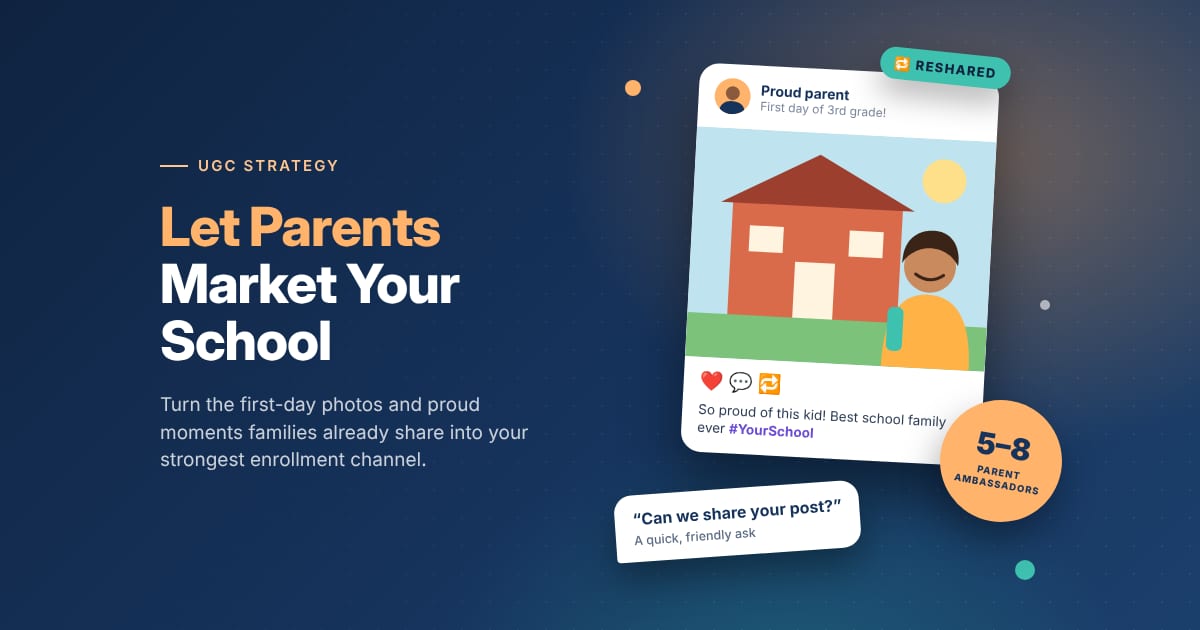
- Reshare every tagged post through your school's official account within 24–48 hours. This signals to your community that their content gets seen and valued, which dramatically increases ongoing participation.
Over one semester, a consistent hashtag effort builds a searchable archive of authentic family content that prospective parents stumble on organically during their school-choice research — essentially a living, always-updating gallery of social proof for your charter school enrollment marketing that costs you nothing to produce.
Tactic 2: Create a "UGC Permission + Repurposing" System
Collecting UGC is useless if you can't use it beyond a single reshare. The real leverage in 2026 comes from repurposing parent and student content across your entire enrollment funnel — in paid social ads, on your website enrollment page, in email nurture sequences, and in open house slide decks.
This requires a lightweight permission system that most schools skip entirely:
- Add a media consent opt-in to your re-enrollment and new enrollment forms — not buried in fine print, but a warm, positive prompt: "I'd love to share our family's story — tag us at @[SchoolHandle] or use #[YourHashtag] for a chance to be featured."
- DM or email parents directly when they post something exceptional, asking explicit one-time permission to use it in your school's marketing materials. Most will say yes enthusiastically, and being asked makes them feel like valued community members — which deepens loyalty and generates more content.
- Build a simple content folder (Google Drive or Notion works fine) organized by theme: classroom moments, sports and arts highlights, parent quotes, student milestone videos, enrollment-decision stories. When you need content for an ad creative or a landing page refresh, you pull from the folder instead of scheduling a photo shoot.
Transitioning from solely creating content to curating community-driven stories conserves valuable time and resources while significantly boosting engagement and enrollment interest. For a school with a small marketing staff — or a principal doing it alone — this is a genuine game-changer. You stop being content creators and start being content curators.
Tactic 3: Launch a Parent UGC Ambassador Cohort (5–8 People, Low Lift)
This is the highest-leverage, most underused tactic in charter school enrollment marketing. It's not a formal ambassador program with contracts and stipends — it's a small, intentional group of your most enthusiastic current parents who agree to occasionally share their authentic experience publicly.
Here's how to structure it without overcomplicating it:
- Identify 5–8 parents who are already active on social media and visibly proud of your school. Look for the ones who tag you unprompted, comment on your posts, or consistently bring friends to open houses.
- Host one 45-minute coffee chat — in person or virtual — at the start of the school year. Tell them they're your school's "community storytellers." Explain what kinds of content are most helpful to prospective families (day-in-the-life moments, milestone posts, candid reactions to school events), hand them your branded hashtag, and give them a simple one-page tip sheet with content ideas and your handle.
- Create a private group chat (WhatsApp or GroupMe) where you give them advance notice of upcoming events, drop occasional content prompts, and publicly thank them in your newsletter when they post.
No scripts. No inauthenticity. Just structure around what they'd do anyway. The goal is to channel existing enthusiasm — and to diversify your content across different family backgrounds, grade levels, and program experiences, which is exactly what prospective families at different stages of the school-choice decision need to see.
The core of a parent ambassador program lies in recruiting enthusiastic parent volunteers as official advocates — but "training" at the charter school level means one honest conversation, not a corporate onboarding deck.
What Not to Do: The Authenticity Tax
One critical warning that most school marketing guides skip: heavily editing UGC destroys what makes it valuable. A slightly shaky phone video of a student explaining what they love about your school beats a professionally edited brand video almost every time right now, precisely because it looks unscripted and unsponsored.
54% of consumers actively identify and distrust AI-generated brand content. The moment you take a parent's raw social post and polish it into a branded graphic with your color palette and logo treatment, you've erased the trust signal that made it worth using in the first place. Use parent and student content as close to its original form as possible. A subtle logo watermark is fine. A full creative rebrand is not.
Imperfection is not a bug in UGC — it's the feature.
The 2026–27 Enrollment Window Is Open Right Now
The families deciding on 2026–27 are doing their research right now — scrolling Facebook groups, checking Instagram tags, searching your school's name on YouTube. What they find in those unguarded, peer-driven spaces will determine whether they submit an inquiry or quietly move on to the next option.
A polished website with stock photos of diverse, smiling children won't decide it. Neither will a well-crafted mission statement. What will decide it is whether another parent — a real one, with a real kid at your school — has left a digital trail of honest, enthusiastic content that a searching family can find and trust.
Your community is already creating that content. Some of it exists right now, untagged and undiscovered, on personal Instagram accounts and in group chat screenshots. The only question is whether your charter school enrollment marketing has a system to surface it, capture it, and amplify it to the families who need to see it most.
Start with the hashtag. Build the folder. Invite five parents to coffee. That's your entire UGC strategy for this month — and it compounds every semester from here.
If your school's marketing still relies primarily on content your team creates, it's time to rethink the strategy. Your most credible enrollment marketers are already in your community — they just need a structure that makes it easy to show up.