The Search Results Your Charter School Isn't Showing Up In (Yet)
A parent opens Google and types: "What's the best charter school for math and science in [your city]?" They don't scroll through links. An AI-generated paragraph appears at the top of the page — a confident, synthesized answer that names two or three schools. If your school isn't one of them, that family may never click your website, read your reviews, or attend your open house. They already have their answer.
This is the new front line of charter school enrollment marketing, and most schools have no idea it exists.
The discipline reshaping this dynamic is called Generative Engine Optimization (GEO) — the practice of structuring your content, your Google Business Profile, and your broader digital presence so that AI-powered search tools like Google AI Overviews, ChatGPT, and Perplexity cite your school when generating answers for users. It's fundamentally different from traditional SEO, which focused on earning a position in a ranked list of blue links. GEO is about earning a seat inside the answer itself.
Why This Matters More for Charter Schools Than Almost Anyone
Google AI Overviews appeared in 40.2% of 60,000 local-business queries measured in April 2025, according to Local Falcon's local-search whitepaper — with a separate 2025 study reporting average prevalence of 68% across local business-type queries. These aren't just restaurant and retail searches. School-related queries — "charter school near me," "best K–8 school in [neighborhood]," "schools with STEM programs in [city]" — are increasingly triggering AI-generated answers at the very top of the page, before families ever reach a traditional result.
In traditional search, Google showed a list of websites and sent people to click through them. AI Overviews work differently — they build an answer. Instead of clicking through a stack of tabs and PDFs, more families are turning to AI tools like ChatGPT, Perplexity, and Google AI Overviews to ask questions and receive immediate, synthesized responses. Parents now use these tools to shortlist schools before visiting a single website.
For charter schools, the stakes are uniquely high. Traditional district schools benefit from geographic default — families often simply attend the school in their zone. Charter schools don't have that built-in advantage. Every enrollment is an active choice. If a family's AI-powered search surfaces two or three competitor schools and skips yours entirely, you've lost that family before you ever had a chance to speak with them. Research from Enrollment Catalyst shows that families are increasingly using AI tools to search for and evaluate school options before ever visiting a school's website — and for charter schools, that isn't a trend to watch from a distance. It's an enrollment threat happening right now.
What GEO Actually Requires
Traditional SEO rewarded pages for matching keywords. GEO ensures your content is optimized not just for the search engine results page, but for the AI-generated answers themselves. Generative AI search delivers users a single conversational answer rather than a list of links — and the content it draws from looks very different from typical school marketing copy.
Here's the core problem: most school web pages are written to persuade rather than explain. AI tools don't respond to marketing language. They respond to clear, structured, factual information they can confidently extract and restate. Instead of "We empower every child to reach their full potential," an AI tool needs to read: "Our K–8 charter school in [City] uses a project-based learning model with a 1:17 teacher-student ratio, serving approximately 320 students annually." Specific. Structured. Factual. That's what gets cited.
Content needs to be organized for answers — not just rankings. Plain language, strong data, and clear program detail pages are critical. And critically, reputation signals off your website count as much as the content on it — reviews, local directory listings, third-party mentions, and community citations all help AI engines build a confident picture of who your school is and what it offers.
3 GEO Tactics Charter Schools Can Execute This Month
1. Rewrite Your Key Pages as "Answer Documents"
Audit your homepage, About Us page, and admissions page. For each one, ask a single question: If a parent asked an AI "What is [School Name]?", could this page answer that clearly and completely in one paragraph?
Rewrite the opening section of each page to lead with concrete facts: your location, grade levels served, curriculum model, distinguishing program features, and how to apply. Then add a simple FAQ section at the bottom of your admissions page — written in natural, conversational language — that directly answers the five to seven questions your front-office staff fields most often from prospective families. Generative AI excels at answering direct questions, so your site should anticipate those questions and answer them directly.
Pair that content work with FAQ schema markup on those pages. For education institutions, relevant schema types include EducationalOrganization for your institution's core information and FAQPage schema for pages with structured Q&A. Your web developer can implement this in under an hour, or SEO plugins like Yoast handle it natively in WordPress. Schema sends a clear, machine-readable signal that your content is structured, trustworthy, and quotable by AI systems — and it's one of the most underused tools in charter school enrollment marketing.
2. Treat Your Google Business Profile as AI Infrastructure
Most charter schools set up a Google Business Profile once and never touch it again. In a GEO environment, that's a liability. For local queries, Google's AI leans on the Business Profile as its primary source of truth for facts — hours, categories, services, and location. An incomplete or outdated GBP doesn't just limit your visibility in Maps. It actively undermines your chances of appearing in AI-generated answers.
Here's what to do this month:
- Complete every field. Hours, phone, website URL, address, and business category. Use "Charter School" or "Elementary School" (whichever best fits) as your primary GBP category.
- Write a GBP description that answers the core question. Who do you serve? What makes your program distinctive? What grades do you offer? Lead with facts, not marketing language. Keep it under 750 characters and front-load the specifics.
- List your programs as GBP services. Your STEM track, dual-language program, arts integration curriculum, or project-based model — add each as an individual service with a one- to two-sentence plain-language description.
- Post at least once per week. AI systems heavily favor recent, up-to-date content when generating responses. Short GBP posts — enrollment deadlines, event announcements, brief student spotlights — signal content freshness and keep your profile active in Google's eyes.
3. Build "Citation Fuel" Through Reviews and Local Mentions
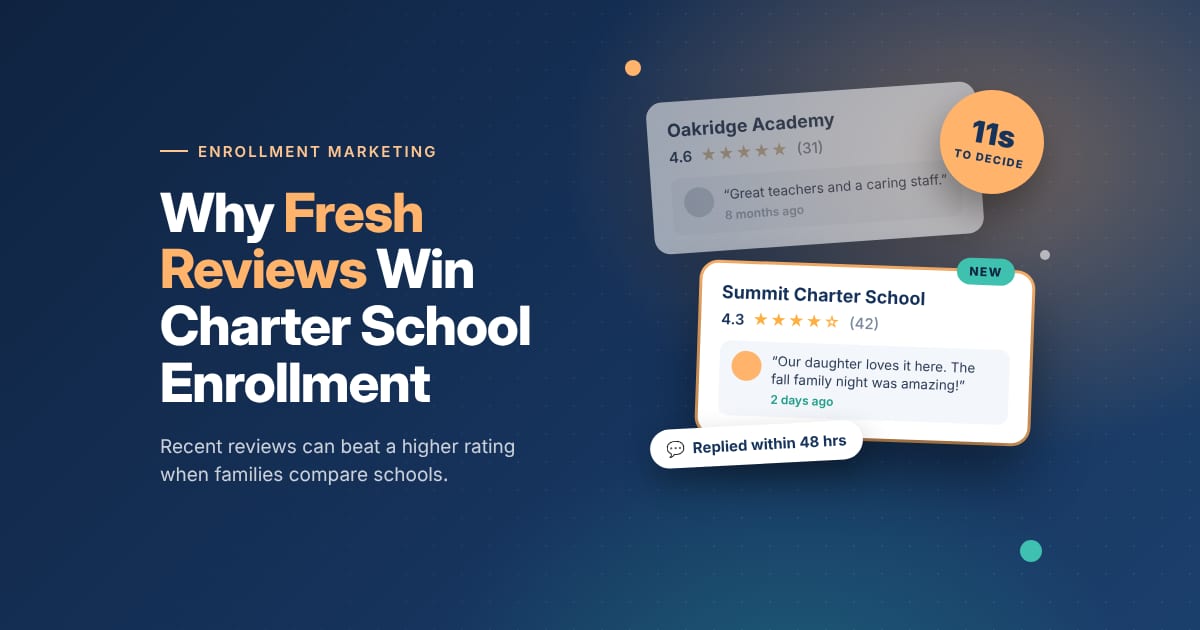
Google AI Overviews regularly synthesize review content from multiple platforms — including Google Business Profile, Yelp, and Facebook — to generate summaries of local businesses. For charter school enrollment marketing, this means your reputation signals need to be broad, consistent, and specific, not just plentiful.
This month, do three things:
Request ten targeted Google reviews. Don't just ask families to leave a review — ask them to mention your school's specific program name, grade levels, and neighborhood in what they write. Reviews that use accurate, detailed language give AI tools structured information to draw from, and they read as far more credible than generic five-star comments with no substance.
Pursue one local editorial mention. Reach out to your neighborhood newsletter, city parenting blog, or local news outlet with a timely angle — an enrollment deadline, a student achievement story, or a new program launch. A feature in a prominent local outlet or a link from a reputable educational organization sends significant authority signals to both traditional search engines and AI tools.
Publish one piece of community-referenced, hyper-local content. Write a 600-word blog post titled something like "How [School Name] Prepares [City] Students for Middle School" or "What Makes [Neighborhood] Families Choose [School Name]." Schools that specialize and produce focused, authoritative content on a specific niche can surface in AI answers above much larger competitors. This kind of entity-rich, geographically specific content is exactly what AI search tools are trained to quote.
The Metric That's Replacing Rankings
Local SEO visibility is no longer determined by rankings alone. Google AI Overviews now surface businesses based on citations, reviews, and entity trust — often before users ever see the traditional local map pack. The primary success metric for local search is shifting from who ranks highest to who gets named in the answer.
For charter schools, this is both a warning and an opening. Being included in a generative AI response is the new measure of local visibility — and right now, most of your competitors aren't optimizing for it. The schools that restructure their content, complete their GBP, and build local citation authority before the next enrollment season will own the AI answer box. The ones that don't will keep losing first impressions to schools they may genuinely outperform in academics, culture, and outcomes.
Families are asking AI tools which schools to call first. Make sure your school is the name in the answer.
Time to Rethink Your School's Search Presence
GEO isn't a technical luxury reserved for schools with large marketing teams or big budgets. It's a practical, low-cost shift in how you write about your school and how you structure that information online. The schools winning in AI search aren't necessarily the best-funded — they're the ones whose content is clearest, most specific, and most consistently maintained across their website, their GBP, and their local reputation footprint.
If your charter school enrollment marketing strategy doesn't yet account for how AI tools find, interpret, and cite school information, now is the right time to close that gap — before the next enrollment cycle opens and families start asking AI for recommendations you're not showing up in.