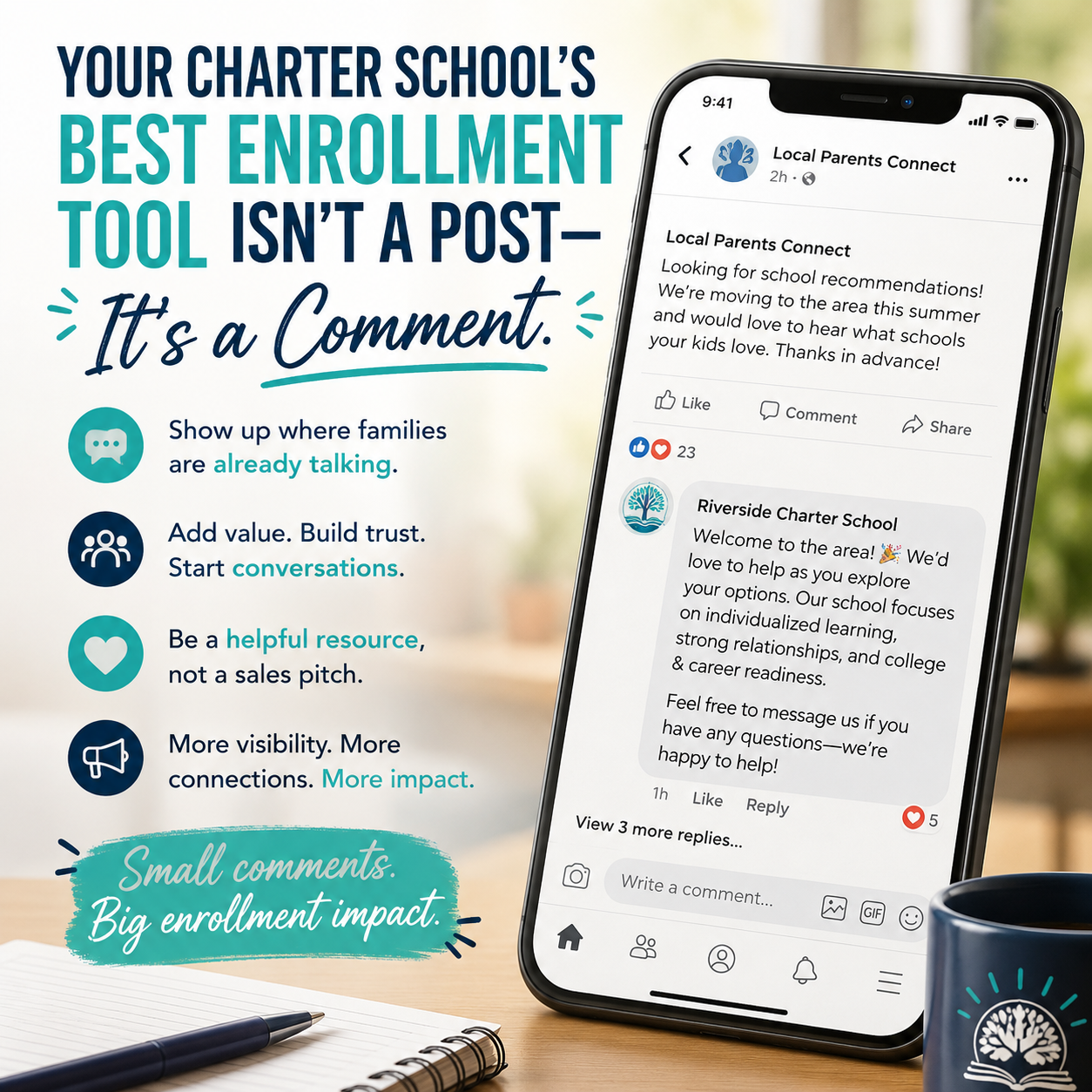
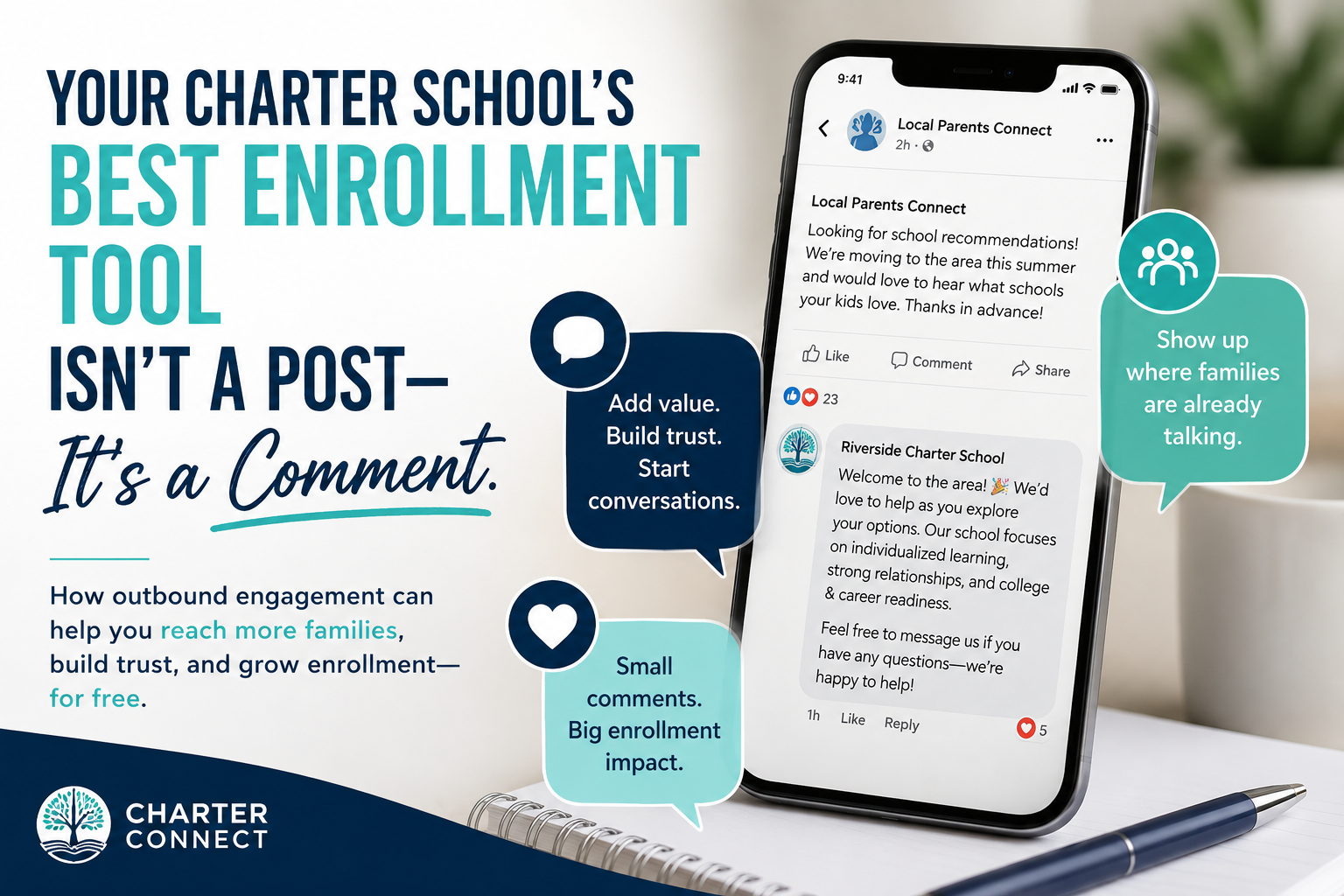
Your Charter School's Best Enrollment Tool Isn't a Post — It's a Comment
Most charter school social media strategies follow the same playbook: post a classroom photo, share an event flyer, maybe go live for open house season. Then wait. And wait. The problem isn't the content — it's the posture. You're broadcasting into a void and hoping families stumble across you.
Meanwhile, a fast-moving trend is reshaping how smart brands earn visibility without paid ads or viral luck: outbound engagement, also called comment marketing. Instead of waiting for your audience to find you, you go to them — showing up strategically in the comment sections where the families you want to reach are already having conversations.
According to Hootsuite data, 41% of brands have already started testing outbound engagement — proactively commenting on the posts of creators and community accounts — specifically to reach new audiences and build online community presence. For charter school enrollment marketing, this is one of the most underused, zero-cost tactics available right now. And unlike most marketing trends, it requires no budget, no design skills, and no agency. It requires intentionality.
What Outbound Engagement Actually Means (and Doesn't)
Let's be clear about what this is not. Outbound engagement is not dropping "Check out our school!" on every neighborhood Facebook post. That's spam, and it will get you ignored — or worse, blocked and reported.
Done strategically, outbound engagement means:
- Targeting creators and local accounts your ideal families already follow
- Adding to conversations with genuine insight, humor, or empathy — not sales language
- Staying consistent with your school's voice and values across every interaction
- Timing it right — jumping into comment sections while posts are fresh and active, when visibility is highest
Algorithms reward content that sparks conversations, and audiences reward brands that feel human. Outbound engagement hits both. It expands your school's visibility by placing you in high-traffic comment sections that your own followers never see — reaching cold audiences who haven't discovered you yet.
For charter schools, this matters enormously. You're not a household name the way a district school is. Every new family you reach is a family that had to find you, often through word of mouth or a lucky search. Outbound engagement is how you engineer that discovery — at scale, for free.
Why This Works Especially Well for Charter Schools
Charter schools operate with a structural trust deficit. Many families — especially those new to the charter model — don't know you, don't know what you stand for, and may carry skepticism about what charter even means. Traditional ads can interrupt their attention. A thoughtful comment on a post they already care about can earn it.
There's a meaningful distinction here: when a brand comment adds real value to a conversation, it doesn't read as marketing. It reads as a knowledgeable neighbor chiming in. And for charter schools, that neighborly credibility is exactly what drives enrollment decisions.
Charter schools also have a natural authority lane that most brands don't: education, child development, and community wellbeing. When your school account drops a genuinely helpful response under a parenting post — say, a question about reading development, managing school anxiety, or navigating IEP processes — you're not being salesy. You're demonstrating the exact values families are evaluating when they choose a school. That's charter school enrollment marketing doing its job invisibly, in the wild, where families actually live online.
3 Outbound Engagement Tactics to Implement This Month
Tactic 1: Map Your "Watering Holes" — The Accounts Your Prospective Families Already Follow
Before you comment on anything, invest 20 minutes in reconnaissance. You need to find the online spaces where your target families are already spending time and engaging actively. These are your watering holes. For most charter schools, they include:
- Local parenting bloggers or "mom/dad influencers" in your city or target zip codes
- Neighborhood Facebook groups — even if your school page can't comment directly, your principal or enrollment director can participate personally and organically mention the school when relevant
- Youth sports leagues, dance studios, rec centers, and kids' activity accounts — followed almost exclusively by families with school-age children
- Local news outlets' social accounts covering education, community events, or family lifestyle topics
- Local pediatricians, tutoring centers, or children's therapists who post educational content for parents
Make a running list of 8–12 accounts. Set calendar blocks — 15 minutes, three times per week — dedicated entirely to monitoring these accounts and leaving thoughtful responses whenever a relevant post surfaces. Don't wait to feel inspired. Schedule it like any other marketing task.
Tactic 2: Use the "Add Value, Don't Advertise" Commenting Rule
Every comment your school leaves should pass a single test: Would this comment be valuable even if our school's name weren't attached to it?
If a local parenting account posts "What do you wish you'd known before choosing a middle school?" — the wrong reply is "Come to our open house next Thursday!" The right reply sounds like this:
"One thing parents often overlook is asking what happens when a student struggles mid-year — not just when they're thriving. The intervention and support systems reveal a school's real culture more than any open house ever will."
That comment does four things simultaneously:
- It positions your school account as knowledgeable and thoughtful
- It earns likes and replies from other parents in the thread, organically expanding your reach
- It drives curious families to click your profile — where your bio, highlights, and link should be enrollment-ready
- It does not feel like an ad
On Instagram and TikTok especially, effective outbound engagement goes well beyond "Love this!" The comments that earn visibility share a specific insight, ask a meaningful follow-up question, or reframe the original post in a way that sparks more conversation. Practice writing comments that would make a parent think "Whoever runs that account actually gets it." That reaction is the entire goal.
Tactic 3: Build a Comment-to-DM Pipeline for Warm Leads
Outbound engagement isn't just awareness-building — it can function as a direct enrollment pipeline if you attach a lightweight follow-up system to it.
Here's the simple flow:
- Your school account (or a staff member's personal account) leaves a thoughtful, value-adding comment on a relevant post.
- A parent replies to your comment, likes it, or tags a friend.
- Within 24 hours, you send a brief, low-pressure DM: "Hi! I noticed your question about [topic] — happy to share a bit more about how we handle that at [School Name] if it would be helpful. No pressure at all, just happy to be a resource."
- Log every interaction in a simple spreadsheet: name, platform, date, topic discussed, and outcome.
This is not aggressive. It is responsive. You are meeting a parent at the exact moment of curiosity — which is precisely when enrollment conversations should start. The DM doesn't close an enrollment; it opens a relationship. And relationships are what fill seats.
What to Track So You Know It's Working
Outbound engagement results are real but not always immediate. Track these leading indicators on a monthly basis:
- Profile visits during active commenting weeks versus passive weeks
- DM volume from contacts who are not existing families
- Follower growth rate sourced from your targeted watering hole accounts
- Tour and open house inquiries where families mention "I saw your comment on [account name]"
That last one is your most powerful data point — and you can start collecting it immediately. Add a single question to every tour registration form and every welcome phone call: "How did you first hear about us?" Then actually track the answers. Within one semester, patterns will emerge that show you exactly which online spaces are driving the warmest leads.
The Bigger Picture: Enrollment Marketing That Works Before Families Are Looking
The best charter school enrollment marketing doesn't only reach families who are actively searching for a new school. It builds familiarity with families who aren't looking yet — because when their situation changes (a rough school year, a move, a new sibling's needs), your school is the first name they think of.
Outbound engagement is how you plant that flag months or even years before a family ever fills out an inquiry form. Every useful comment is a deposit in a trust account. You're not asking for anything. You're just showing up, being helpful, and being present — consistently, in the right rooms.
For a charter school with a small team and a tight marketing budget, this is not a limitation. It is actually an advantage. You can be more human, more specific, and more genuinely rooted in your community than any district communications office ever could. Big systems publish; you can participate.
Stop Waiting for Families to Find You
If your school's current social strategy is mostly about publishing and hoping, it's time to flip the model. Outbound engagement costs nothing but a few intentional minutes several times a week — and it puts your school name in front of families who've never heard of you, inside conversations they already care about.
Start small: identify three local accounts this week, leave one genuinely useful comment on each, and see what happens. Then build the habit. Because the charter schools that consistently show up in community conversations are the ones families consistently choose when enrollment season arrives.
Your marketing strategy should work as hard as your teachers do. If it's time for a reset, start with where your families already are — and show up there first.